
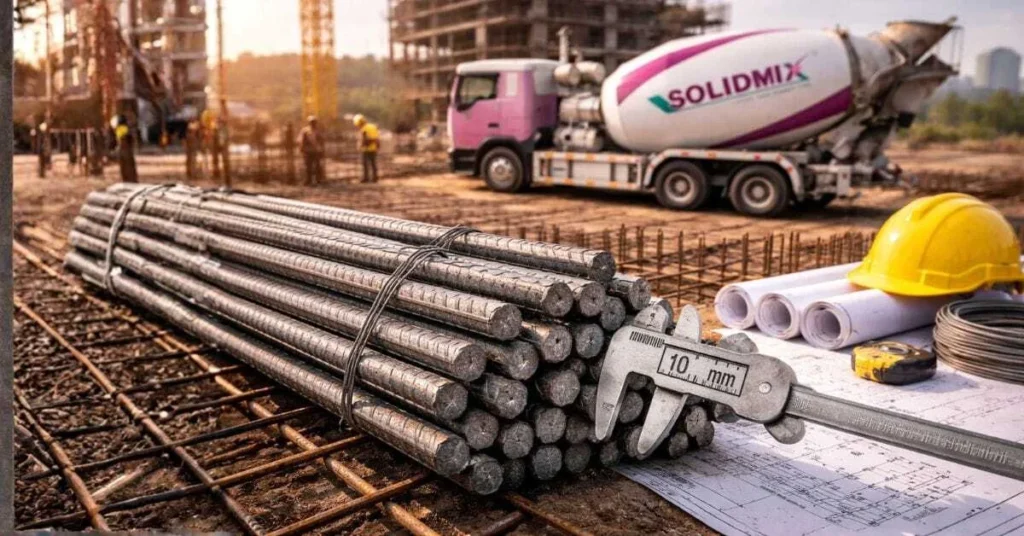
In the world of construction, precision is everything. Whether you are building a small residential home or a massive industrial complex, knowing the exact specifications of your raw materials is crucial. One of the most common materials used in reinforcement is the TMT bar, specifically the 10mm diameter rod. Understanding the 10mm rod weight is not just a technical detail; it is a fundamental requirement for structural engineers, contractors, and homeowners to ensure safety and manage costs effectively.
Steel reinforcement provides the necessary tensile strength to concrete, which is naturally strong in compression but weak in tension. The 10mm rod is often considered the “versatile middle ground” in reinforcement, used extensively in slabs, stirrups, and small beams. In this guide, we will dive deep into how to calculate the weight of these rods, why it matters, and how it compares to other sizes like the 8mm rod weight.
Why Calculating Steel Weight is Important
Before we get into the numbers, we must understand the “why.” You don’t buy steel by the piece; you buy it by the weight (usually in kilograms, quintals, or tonnes). If your estimation is off, your budget will be too.
Furthermore, structural integrity depends on the density of the steel. If a 10mm rod weighs significantly less than the standard theoretical weight, it might be of poor quality or underweight, which could compromise the safety of the entire building. Engineers often cross-verify the 12mm rod weight alongside the 10mm options to decide which diameter provides the best reinforcement-to-weight ratio for specific structural elements.
The Standard Formula for Steel Rod Weight
To find the weight of any circular steel bar, we use a standard mathematical formula derived from the density of steel. Steel has a density of approximately $7850 kg/m^3$.
The formula used globally is:
$$W = \frac{D^2}{162}$$
Where:
- $W$ = Weight of the rod in Kilograms per Meter ($kg/m$).
- $D$ = Diameter of the rod in Millimeters ($mm$).
Calculating 10mm Rod Weight per Meter
Using the formula above, let’s calculate the specific weight for a 10mm bar:
- $D = 10mm$
- $D^2 = 10 \times 10 = 100$
- $100 / 162 = 0.617$
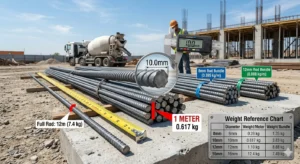
Therefore, the standard 10mm rod weight is 0.617 kg per meter.
Weight of a Full 10mm Length Rod
Standard TMT bars manufactured in factories usually come in a length of 12 meters (approximately 40 feet). To find the weight of a full single rod, you simply multiply the per-meter weight by 12.
- $0.617 \times 12 = 7.404 kg$
So, one full 12-meter long 10mm rod weighs approximately 7.4 kg.
Comparing 10mm with 8mm Rod Weight
In many residential projects, 8mm rods are used for stirrups (rings) or for temperature reinforcement in slabs. However, the 8mm rod weight is significantly lower than the 10mm variant.
Applying our formula ($8^2 / 162$), we find that an 8mm rod weighs approximately 0.395 kg/m. When choosing between 8mm and 10mm, contractors must balance the lower weight (and cost) of the 8mm rod with the higher structural capacity of the 10mm rod. Using 10mm rods for stirrups in heavy beams is often preferred over 8mm to prevent buckling under high loads.
Understanding 12mm Rod Weight in Heavy Construction
For columns and main beams, a 10mm rod might not always be enough. This is where the 12mm rod comes into play. The 12mm rod weight is calculated as $144 / 162$, which equals 0.888 kg/m.
As you can see, a 12mm rod is nearly 44% heavier than a 10mm rod. This extra mass translates to a higher cross-sectional area, allowing the building to withstand much greater forces. In a typical RCC (Reinforced Cement Concrete) structure, you will often see a combination where 12mm bars are used as main longitudinal reinforcement and 10mm bars are used as distribution bars or in slabs.
Standard Weight Chart for Common Steel Bars
To make estimation easier, here is a quick reference table for the most commonly used reinforcement bars:
| Diameter (mm) | Weight per Meter (kg) | Weight per 12m Bundle (kg) |
| 8mm | 0.395 | 4.74 |
| 10mm | 0.617 | 7.40 |
| 12mm | 0.888 | 10.66 |
| 16mm | 1.580 | 18.96 |
Factors Affecting the Weight of Steel Rods
While the theoretical 10mm rod weight is 0.617 kg/m, actual field weights can vary slightly. These variations are usually due to:
- Rolling Margin: Manufacturers have a permissible tolerance (usually +/- 3-7%). If the rod is slightly thicker or thinner due to the rolling process, the weight will shift.
- Rust and Corrosion: Steel stored in humid conditions develops a layer of rust. While light surface rust doesn’t change weight much, heavy scaling can reduce the effective diameter and weight.
- Brand Quality: Reputable brands follow Bureau of Indian Standards (BIS) guidelines strictly to ensure that the 10mm rod weight stays within the legal tolerance limits.
For official guidelines on steel specifications and construction safety standards, you can refer to the Bureau of Indian Standards (BIS), which regulates the quality of TMT bars in the country.
How to Calculate Total Steel Requirement for a Slab
If you are casting a roof slab, you need to know how many kilograms of steel to order. Let’s say your slab requires 100 meters of 10mm reinforcement.
- Total Weight = $100 \times 0.617 = 61.7 kg$.
If you were using 8mm bars for a different section, you would use the 8mm rod weight of 0.395 kg/m to find that 100 meters would only weigh 39.5 kg. This calculation is the backbone of any construction “Bill of Quantities” (BOQ).
Tips for Buying 10mm Steel Rods
- Check for the ISI Mark: Always look for the ISI stamp on the rod to ensure it meets quality standards.
- Weight Sample: At the yard, weigh a 1-meter piece. If it is significantly lower than 0.617 kg, the steel is likely “under-gauge” and should be rejected.
- Storage: Ensure the rods are kept off the ground on wooden blocks to prevent moisture absorption.
While 10mm is great for slabs, always consult a structural engineer before substituting it for a higher 12mm rod weight bar in critical areas like columns.
Conclusion
Understanding the 10mm rod weight is essential for anyone involved in building and construction. By using the $D^2/162$ formula, you can quickly estimate your material needs, verify the quality of the steel delivered to your site, and keep your project on budget. Whether you are comparing it against the lighter 8mm rod weight for stirrups or the heavier 12mm rod weight for main reinforcement, being informed helps you build stronger, safer structures.
Frequently Asked Questions (FAQ)
- What is the weight of a 10mm steel rod per bundle?
A bundle of 10mm rods usually contains 7 or 8 pieces depending on the manufacturer. If a bundle has 7 pieces of 12 meters each, the total weight would be $7 \times 7.404 = 51.8 kg$.
- Is 10mm rod enough for a house slab?
Yes, 10mm TMT bars are the standard choice for main reinforcement in residential slabs, often spaced 4 to 6 inches apart, depending on the engineer’s design.
- Can I use 8mm instead of 10mm?
It is not recommended to swap 10mm for 8mm unless specified by an engineer. Since the 8mm rod weight is lower, it has less load-bearing capacity and could lead to structural cracks.
- How many 10mm rods are in 1 ton?
One ton is 1000 kg. Since one 10mm rod (12m) weighs roughly 7.4 kg, there are approximately $1000 / 7.4 \approx 135$ rods in one ton.
- How does the weight of 10mm compare to 12mm?
The 12mm rod weight is about 0.888 kg/m, whereas the 10mm is 0.617 kg/m. The 12mm rod is roughly 1.44 times heavier than the 10mm rod.
Read More Blogs Here
If you found this guide helpful, we have plenty of other resources for you. Check out our detailed analysis of construction material costs and modern architectural designs.
Stay tuned for more technical deep-dives into reinforcement steel and site management tips. We regularly update our blog with the latest industry standards to help you build your dream project with confidence.