
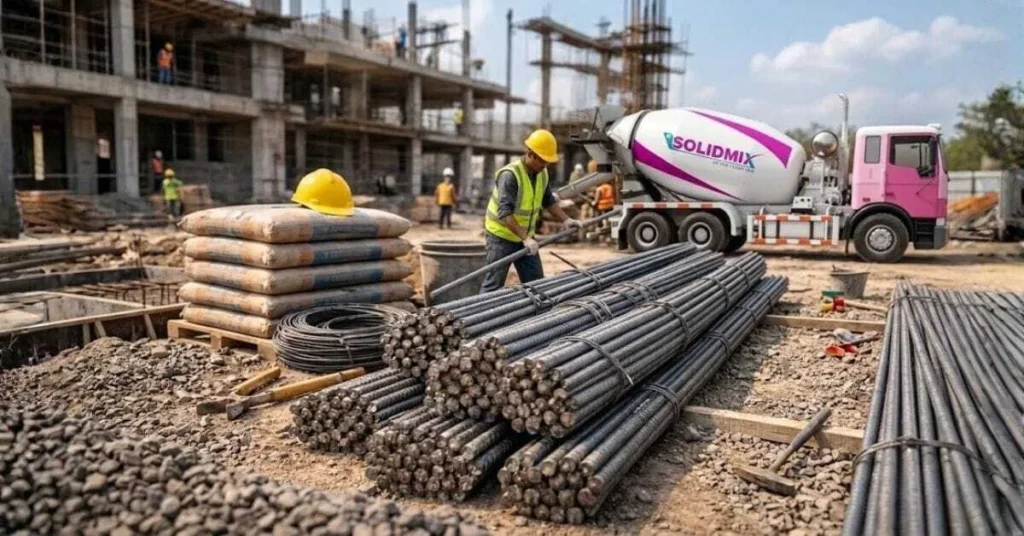
Understanding 12mm rod weight is important for anyone working in construction. Builders, contractors, and engineers use this value daily to estimate steel requirements and manage costs properly.
Steel reinforcement supports the strength of concrete structures. Even a small miscalculation can affect both budget and safety. That’s why knowing the correct weight and how to calculate it matters on every project.
What is 12mm Rod Weight?
A 12mm rod is a steel reinforcement bar with a diameter of 12 millimeters. It is widely used in structural elements like beams, slabs, and columns.
Standard Weight Per Meter
The standard weight of a 12mm rod is:
0.888 kg per meter
This value is commonly used for quick calculations on-site.
Formula to Calculate 12mm Rod Weight
You can calculate the weight of any steel rod using a simple formula.
Weight Calculation Formula
Weight (kg/m) = (D × D) / 162
Where D is the diameter in millimeters.
Example Calculation
For a 12mm rod:
12 × 12 / 162 = 0.888 kg per meter
This formula helps in planning steel quantity accurately for any construction project.
Why 12mm Rod Weight Matters
Accurate weight calculation is not just about numbers. It directly impacts project efficiency and safety.
Key Benefits
- Helps estimate total steel requirement
- Reduces material wastage
- Supports better budget planning
- Ensures proper load distribution
- Improves structural performance
Knowing the correct 12mm rod weight avoids unnecessary delays and extra costs.
Comparison with 10mm Rod Weight
Different rod sizes serve different purposes in construction.
Weight Comparison
- 10mm rod weight = 0.617 kg/m
- 12mm rod weight = 0.888 kg/m
Usage Difference
10mm rods are generally used in slabs and light reinforcement, while 12mm rods are used in beams and columns where higher strength is required.

Role of Binding Wire in Construction
Binding wire is used to tie reinforcement bars together and keep them stable.
Why Binding Wire is Important
- Holds steel bars in position
- Prevents shifting during concrete pouring
- Easy to use and flexible
- Essential for RCC structures
Practical Use on Site
Workers use binding wire to connect 12mm rods securely before pouring concrete. Without it, the structure may lose alignment.
Applications of 12mm Rod
12mm rods are used in many types of construction work.
Common Uses
- RCC beams
- Columns
- Foundations
- Slabs in buildings
- Infrastructure projects
Where Strength Matters Most
These rods are ideal for areas where load-bearing capacity is important.
How to Calculate Total Steel Requirement
Proper calculation helps in avoiding waste and shortages.
Example Calculation
If you need 100 meters of 12mm rod:
100 × 0.888 = 88.8 kg
Things to Consider
- Add 2–5% extra for wastage
- Check design requirements
- Measure correctly before ordering
Tips for Accurate Calculation
Small steps can improve accuracy a lot.
Best Practices
- Always use the correct formula
- Verify rod diameter before calculation
- Keep track of usage on-site
- Use proper measuring tools
- Avoid rough estimates
Common Mistakes to Avoid
Mistakes can increase cost and reduce quality.
Frequent Errors
- Using the wrong diameter
- Ignoring binding wire requirement
- Not including wastage
- Mixing rod sizes without planning
- Relying only on guesswork
Importance of Standard Guidelines
Using approved standards ensures quality and safety.
Government Approved Reference
For official standards, refer to:
https://www.bis.gov.in/
This ensures materials and practices follow proper guidelines.
Benefits of Using Correct 12mm Rod Weight
Accurate calculation improves overall project performance.
Key Advantages
- Better structural strength
- Controlled material usage
- Improved project planning
- Faster execution
- Reduced extra cost
Real Site Scenario
Why Calculation Matters in Real Work
On many sites, workers depend on experience. But for large projects, exact calculations are necessary.
Using 12mm rods where required ensures strength, while incorrect usage may lead to structural issues. Proper planning always gives better results.
Conclusion
Understanding 12mm rod weight is essential for safe and efficient construction. It helps in proper planning, cost control, and maintaining structural quality.
When combined with correct use of binding wire and comparison with sizes like 10mm rod weight, it creates a balanced and strong structure.
Every successful project depends on accurate calculation and proper execution.
FAQs
Q1. What is the weight of a 12mm rod per meter?
It is 0.888 kg per meter.
Q2. How is 12mm rod weight calculated?
Use the formula (D × D) / 162 where D is the diameter.
Q3. What is the difference between 10mm and 12mm rod weight?
10mm rod weighs 0.617 kg/m, while 12mm rod weighs 0.888 kg/m.
Q4. Why is binding wire used?
It is used to tie steel rods and keep them stable during construction.
Q5. Where is 12mm rod commonly used?
It is used in beams, columns, slabs, and foundations.